Freedom Ship - The Floating City
No cruise ship that has ever been built can compare to the enormity of Freedom Ship. Imagine a mile-long stretch of 25-story-tall buildings in New York City; now imagine that floating on the water. If you can picture that, then you get the general idea of Freedom Ship's size. At 4,320 feet (1,317 meters) long, 725 feet (221 m) wide and 340 feet (103 m) tall, the ship is taller than the length of a football field and wider than two football fields put together. And not only can a ship that size float on water, but it may be navigating the world's oceans as early as 2005.
Freedom Ship will dwarf any ocean-going vessel operating today -- it will be more than four times longer than any current cruise ship.
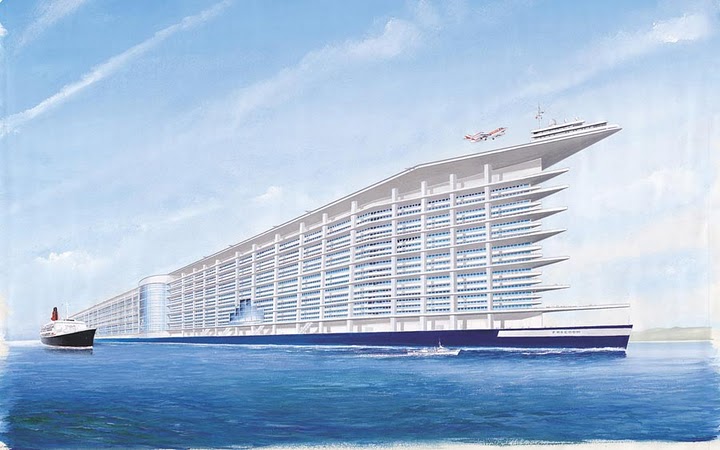
This is ship Freedom, dream yacht futuristik which might possibly will become reality. Possibly You have ever seen conspecific illustration in medias iptek or scientific publications outside there. With all technological advanceses in century 21 likely nothing that not possibly to realized.


Freedom Ship will be built on top of 520 airtight steel cells that will be bolted together to form a sturdy base. Each cell will be 80 feet (24 meters) tall, between 50 and 100 feet (15 and 30 m) wide and between 50 and 120 feet (15 and 37 m) long. These cells will be assembled to form larger units that are about 300 x 400 feet (91 x 122 m). These larger units will then be taken out to sea, where they will be put together to form the ship's nearly mile-long base. The rest of the ship will be constructed on top of this base. Norman Nixon, who developed the idea of a floating city, has said that it will take about three years to finish the ship once construction begins.
It will take a tremendous amount of engine power to push the gigantic ship through the water. The vessel will be equipped with 100 diesel engines that can generate 3,700 horsepower each. Developers project the cost of each engine to be about $1 million. That may give you an idea of how expensive the project is, although the total cost of Freedom Ship has not been released. The ship's high construction cost will be passed on to residents, who will pay up to $11 million to purchase living space on the floating city. In the next section, you'll find out what these residents will get for such a price.
Future Flight - The Next 100 Years
NASA recently presents its(the concept about future aeroplane, bigger, more efficient, and a few looked to be odd, but still not as odd and makes is vexed like other concepts, including here nuclear energetic planes and airport in atmosphere.

this NASA Concept based on design scramjet, and possibly will become reality of during 20 years which will come. But remain to only, some in drawing that is a few looked to be too are optimistic.
Flight's first editor Stanley Spooner had little trouble deciding what story would be the lead in our inaugural issue 100 years ago - "A Second Englishman Flies" was our first headline. But back in those pioneering early days, what would Spooner have predicted for the top aerospace story a century later?
Even the most enthusiastic aeronauts and aviators in 1909 would have struggled to believe the way in which powered flight would evolve during the magazine's first 100 years: that the aeroplane would be "going to war" within five years that passengers would be travelling in shirtsleeve comfort across the Atlantic at twice the speed of sound within 70 years or that within 80 years a winged spaceplane would be regularly blasting into orbit and returning to earth as a glider.


CONSOLIDATION DRIVER
The driver for new airliners will be the shape of the industry that flies them. If today's drive for consolidation through alliances and mergers is allowed to run its course (assuming the regulatory environment is adjusted to permit it), then there could end up being just three major airline groups - perhaps one for each continent - "America Air", "Europe Air" and "Asia Air" - or three international global network carriers slugging it out through hubs in Europe, the Gulf and South-East Asia.
Extreme scenarios at each end could see passengers either travelling in ultra-fast and ultra-green jets, or facing a strict rationing of flying because of environmental concerns. The latter could also result in competition being eliminated and route duplication outlawed.

A European future-aviation think-tank, dubbed Out of the Box, is evaluating various "far-out ideas" that could address environmental concerns and enable the airline business as we know it to be sustained. By adopting ground-based power sources for take-off and landing, the aircraft's installed power and systems could be reduced with direct benefit to fuel consumption and weight. Ideas to propel the aircraft aloft include electrical, steam or magnetic devices using oil-based, nuclear or solar energy sources. For landing, aircraft weight could be reduced by eliminating the undercarriage with landings on water or on small cars using electro-magnetic fields to position the aircraft.
Out of the Box also envisages large "cruiser" airliners, possibly nuclear-powered, remaining airborne almost indefinitely flying on circular routes connecting major population centres. Short-range shuttle aircraft would intercept the cruisers and land on or dock for the transfer of passengers and freight.
NASA is gearing its research effort to deliver novel solutions within three aircraft development generations. It has awarded 18-month study research contracts to six industry teams to study advanced concepts for subsonic and supersonic airliners with advanced airframes and propulsion systems.
Dubbed N+3, the concepts should be three generations beyond the current commercial transport fleet that could enter service in 25 to 30 years and able to overcome significant performance and environmental challenges.
Of course a vital element of future air transport will be a restructuring of air traffic management. While a globalised and seamless air traffic system might seem an unachievable dream, it has to be a target. The ongoing effort to create a "Single European Sky" should represent only the beginning, with new technology allowing a high degree of autonomy to enable individual aircraft make their own way through controlled airspace. Could this ultimately lead to pilotless airliners? Some airline chief executives would surely hope so.
The humans that get to keep their place at the controls can expect continuous improvements in the technology at their fingertips, even if the cockpit layout itself becomes much simpler thanks to greater automation. An obvious development would be for the head-up display to become standard, providing navigation data combined with synthetic and enhanced vision, while voice recognition will take care of switch inputs. Meanwhile, increasing automation of flight controls will see the pilot with less manual involvement in the flying - and taxiing - which should lead to an improvement in safety.
Ever-improving surveillance capability will enable satellite-based and real-time four-dimensional operations with constant dataflow between the air and the ground - the latter having the option to take control in an emergency. Such developments would pave the way for single-pilot operations of freighters and other non-passenger carrying flights.
ENGINE TARGETS
The development of engines in the near term will be targeted at lower fuel consumption and emissions, although achieving this in parallel with further significant noise reductions will be a challenge. Geared turbofans, advanced turbofans and open rotors may hold the answer in the shorter term, while efficiency could be improved through recuperation where heat energy is taken from the hot section.
But a clean-sheet approach to power will be needed eventually. The diminishing availability of oil will drive the development of engines compatible with non-fossil-based fuels - for example engines that are capable of direct burning of gaseous or liquid hydrogen derived from water.
Future engines could see on-board power generated directly from their shafts using electromagnets, eliminating the need for an accessory gearbox. However, in the medium term, fuel cells are more likely to provide an answer in the drive to reduce reliance on engines for all on-board power.
As part of the effort to reduce aircraft weight and boost efficiency, the more-electric concept will see electric actuators replace hydraulic systems throughout the airframe.
The JSF will make fifth-generation fighters a reality when it enters service in 2013, but it will still have a little pink body sat at the sharp end controlling it. The US Air Force is working on an "interim" next-generation bomber to augment the B-1B, B-2 and geriatric B-52, which will be also manned. This is notionally aimed for a 2018 debut, but it is more likely to arrive some time in the early 2020s.
As the successors to the Pentagon's original "black jet", the F-117A, the Raptor and F-35 represent the latest interpretation of stealth technology. Where this will go next is unclear - could the technology extend to areas like visual stealth, enabling the creation of 007-style "invisible" helicopters?
While no successor to the F-35 has yet been formally discussed, both the USAF and the US Navy have started talking about a "sixth-generation fighter" to replace F-15s and F/A-18s, starting around 2025. This could be a pilotless concept, taking the shape of an unmanned combat air vehicle like the Boeing X-45 or Northrop Grumman X-47, or a more conventional piloted design, for example a development of the F-22.
If the unmanned route is followed, could this ultimately lead to an autonomous aircraft controlled by an on-board computer that can mimic human cognitive reasoning? If that sounds too far-fetched, then perhaps at least consider that the stores the UCAV carries will be "intelligent munitions" with independent "loiter, search and destroy" capability.
RADICAL BOMBER
A more radical bomber design beyond the interim plan is proposed for 2037. So far there have been few clues on how it will be controlled and what it will look like, although hypersonic performance is clearly among the candidate capabilities.
At the other extreme, work is intensifying on the development of tiny "nano-technology" aircraft that can fly surveillance missions undetected to previously inaccessible locations. Lockheed Martin is already working on a remote-controlled nano air vehicle design under a $1.7 million contract from the US Department of Defense's DARPA research arm.
Beyond the horizon, military concepts could close the gap to spacecraft designs - as they did in the "Right Stuff" era of the X-15 back in the 1960s - leading to the creation of aircraft with hypersonic performance capable of sub-orbital flights. Such aircraft could use air-breathing hypersonic-cruise engines - possibly of all-composite structure - although such performance and technology is more likely to find an initial application on the next generation of air-launched missiles.
Back in the last century, the dawn of space weaponisation came close with US President Ronald Reagan's "Star Wars" plan. The prospect of such capability arriving in the next 100 years must be considered strong, perhaps in the form of a "directed-energy" weapon like a particle beam or laser - pure science fiction or future science fact?
In the military support arena, there may be some radical ideas for mega transports to succeed aircraft like the C-5 Galaxy in the troop transport role. These could take the form of huge blimps or aircraft - for example, a blended wing body design - capable of transporting hundreds of troops and their vehicles and equipment.
General aviation - as we would define it today - was where powered flight originated early in the 20th century, and the next 100 years should see increasing numbers of people being able to enjoy the pleasure of "personal aviation", thanks to the ever greater availability of small, inexpensive and flexible aircraft.
Flying cars transporting people along dedicated "highways in the sky" at low cost on high-volume routes similar to the railway networks operated today, could be the answer to growing road congestion. The new generation of very light and personal jets will become an increasingly viable alternative to the strict regime of commercial flying, at a fraction of the cost of today's business jets. This could fuel the growth of air taxi operations, which would become an integral part of the transport system and open remote and formerly inaccessible areas to businesses and individuals.
At the top end of the market supersonic business travel could become the norm for high net worth customers, as all the major corporate jet airframers develop designs capable of long range and very fast cruise speeds beyond the speed of sound.
Given that the space age was two years old when Flight celebrated its 50th anniversary in 1959, at that time our team of journalists could have been forgiven for making some quite ambitious predictions for interplanetary achievements through the next half century. But the reality has been that after a momentous start - man walked on the Moon the year we reached our 60th birthday - they would probably have expected much more than we have achieved since then.
Having made spaceplanes a reality in 1981 with the Space Shuttle, NASA has decided to return to Apollo technology for its replacement. Sir Richard Branson's efforts apart - he aims to operate his first Virgin Galactic space tourism flights this year - further progress in manned spaceflight will depend on what US president-elect Obama decides to do once he reaches office.
Among the decisions to be made are how and whether to continue with plans to return to the Moon - could an international lunar outpost become a reality in the next 20 years.
The International Space Station is likely to see another decade of service before it is de-orbited. Will its replacement - or the lunar outpost - be built with as much emphasis on commercial tourist flights as on scientific research? And could a manned mission to Mars be nearing reality by the middle of the century?
Longer-term space exploration will depend much on new propulsion technology, such as nuclear-electric "plasma" engines (also known as impulse drives) that could power robotic missions to the outer planets in the solar system. Using fission systems as their basis, such engines could reduce the travel time between Earth and Mars from the six months envisaged.
NEW ROCKET TECHNOLOGY
The xenon gas-powered plasma thrusters used on the latest satellites and interplanetary probes will gain increased power and specific impulse durations as their power source changes from today's solar panels to a simple nuclear device using the heat from a radioactive material, and eventually a fission nuclear reactor. New rocket technology to place spacecraft into orbit will see the slow phasing out of hypergolic propellants and replacement by a liquid oxygen/kerosene for the main engines (or LOx/liquid hydrogen where higher specific impulse is needed).
And lurking in the background throughout all this development will be the possibility that NASA and its partners may one day be called upon to develop a robotic mission to divert an asteroid on a collision course with Earth.
Much of these thoughts for the next 100 years of Flight may appear to be little more than science fiction. But then the same would have been true of the aviation feats that became realities during our first century, to the readers who picked up our inaugural issue in January 1909.
Source : www.flightglobal.com
Eco-city, Town in Crater


Crater made in this it is possible that is the biggest dig aperture in second world. This dig will be closed over by glass arch. This eco-city area wide total reachs 2 million square meters, ready to accommodate 100000.


Weapons of The Future
1. Autonomous weapons

How they work: Onboard computers interpret sensor data to identify and target hostile forces with built-in weapons. Robots may query human controllers at remote sites for the go-ahead to fire, and friendly forces may carry transponders that identify them as “friends”.
Limitations: Difficulty of quickly and reliably discriminating between hostile forces and neutral or friendly parties or objects, such as civilians, cows, trees, and tractors. Systems that check with human controllers are vulnerable to communication failures. Malfunctioning robots could fire wildly at anything.
2. High-energy lasers

How they work: Large mirrors focus powerful laser beams onto a small spot on the target. The heat produced burns through the surface of the target, disrupting flight, disabling warheads, or igniting fuels or explosives.
Limitations: It needs much more energy to do damage than bullets, which destroy targets with their momentum. Powerful lasers need fuel or electrical power and are also very bulky (the US Airborne Laser fills a Boeing 747). Travelling through air and turbulence can disperse the energy of the beam.
3. Space-based weapons

How they work: The main mission of space-based weapons would be to defend against ballistic missiles fired at targets on Earth. Fleets of interceptors or battle stations would be stationed in orbit, poised to fire at any attacking missiles. The leading approach now is solid projectiles – such as tungsten rods- that would impact missiles. But laser battle stations are also under consideration.
Limitations: The technology is immature. Reaction times must be very fast. Interceptors must hit warheads to destroy them, which is difficult. Lasers also need chemical fuel or electrical power which is not readily available in space.
4. Hypersonic aircraft

How they work: To get off the ground from a runway, a hypersonic plane would either hitch a ride on a conventional plane, or have its own conventional jet engine. That engine would carry the hypersonic craft to an altitude where air density and resistance are less. Here it would reach supersonic speeds and then shift to its scramjet engine. The scramjet scoops up air and mixes it with fuel so it burns as the mixture flows through the engine at supersonic speeds. This means scramjets can achieve some of the speed of a rocket without having to carry heavy oxidiser (to mix with fuel), as rockets do.
Limitations: The technology is immature, with many engineering issues unresolved. Scramjets engines can not start until the plane flies faster than the speed of sound. Plus, hypersonic flight has so far only been demonstrated for small unpiloted craft carried to high speed by other vehicles – and other planned experimental craft are too small to carry a pilot.
5. Active Denial System

How it works: A 2-metre antenna and mobile generator produce and aim a beam of 95-gigahertz (3-millimetre) radiation. The top 0.3 mm of skin absorbs millimetre waves, causing intense pain within five seconds, so people flee quickly, if they can.
Limitations: Serious injury is possible if people cannot escape from the beam; skin burns within minutes. The beam also superheats metal objects like coins, earrings, or spectacle frames, which can then burn skin.

How they work: One or more nuclear warheads are mounted on a ballistic missile, and launched vertically. The rocket burns out in the upper atmosphere, then coasts to its programmed destination where the bomb descends and explodes.
Limitations: These weapons are so frighteningly destructive that they have never been used in war (the Hiroshima and Nagasaki bombs – which had much less destructive power – were dropped from aircraft). Plus, the launch site and trajectory are easy to identify, inviting retaliation in kind from the target nation.
7. Stun guns (Tasers)

How it works: A special gun fires darts on wires. These deliver a pulse of electricity that temporarily disrupts control of voluntary muscles. Police target body or legs to avoid vulnerable areas such as head and neck. Without muscle control, people fall to the ground.
Limitations: Tasered people may be injured when they fall to ground. Darts can injure the throat, eyes, or genitals. Pulses can cause muscle spasms or seizures, and deaths have been reported. One pulse does not stop all people, and there have been allegations of misuse of stunguns, and claims of their use in torture.
8. E-bombs

How they work: A rapid increase in electromagnetic field strength during a pulse, induces surges of electric current in conductors. This burns out electrical equipment – semiconductor chips are particularly vulnerable. Special bombs generate the most intense pulses covering large areas, but unmanned aircraft carrying smaller generators can pinpoint targets.
Limitations: The effects can depend on local conditions, and are hard to predict. Sensitive enemy military equipment can be shielded, and microwaves also disable friendly electronics within range.
9. Layered missile defence

How it works: Multiple anti-missile systems are deployed to target ballistic missiles during different stages of the attacking missile’s flight: (1) The boost phase, while the rockets firing engines makes it easy to spot; (2) Mid-course, while the warhead coasts in space, and; (3) The terminal phase, as it approaches the target. Each phase, or layer, of defence increases the chance of successful destruction of the missile.
Limitations: Depends on efficiency of each layer. The system is very expensive to build, test, deploy, and maintain. The initial boost phase is easiest to target, but requires extremely fast reaction times.
10. Information warfare

How it works: Information warfare specifically targets communication networks and computers. Expert computer hackers, called crackers, might break into or overload military computers and networks, or spread computer viruses. Jammers might also block radio and television transmissions. Misinformation is circulated deliberately.
Limitations: The US relies more on computers and communications than most of their potential adversaries – making the technique a potential threat to them, and of limted use against low-tech opponents. Both side are also vulnerable to mis-information.
Luigi Colani - Future Trucks Today


Top 10 Futuristic Concept Cars
10. Magnet Car

9. Audi Locus

Turkish designer Ugur Sahin descirbed the main feature of the car as “the way its surface shapes are formed with continous flow”. He also comments that he was inspired by nature, in that there are no straight lines in nature. Its most outstanding features is the roof, which combines the windshield and the rear window into one continous glass surface. In Sahin’s words, he wanted to create a car that “creates a relaxing, energetic, vibrant and confident feeling”.
8. BRB Evolution


7. Audi RSQ Concept

6. Audi O

5. BMW ZX-6


4. Peugeot Flux


The hood and side body panels are made from plastics; seatsare in polyurethane and the mechanical parts are made of aluminium. The main components such as the chassis and head protection are metal.
3. M-112 “TINY” Car Concept


2. BMW Gina Concept


Unlike traditional cars, various aspects of the bodies substructure are moveable and can be shifted by means of electro-hydraulic controls, changing the shape of the outer skin and overall design. One interesting example of this feature, becomes apparent in the headlight arrangement. When the headlights are not active they are hidden under the special fabric cover, as soon as the driver turns on the lights, the contour of the front ends changes revealing the headlights, looking a lot like a character out of the Pixar movie “Cars”.
The whole point of this exercise is to prove that rigid body panels (as they are today) are not a necessary design element and do not significantly improve the overall safety of the automobile. Most crumple zones are 100% dependent on good frame design and materials.
1. Ferrari Monza


Hyper-computerized vehicle designed by Iman Maghsoudi, this one is a perfect portrayal of his belief that driving cars in the future will be like operating a PC while zooming at 200 km/h.


